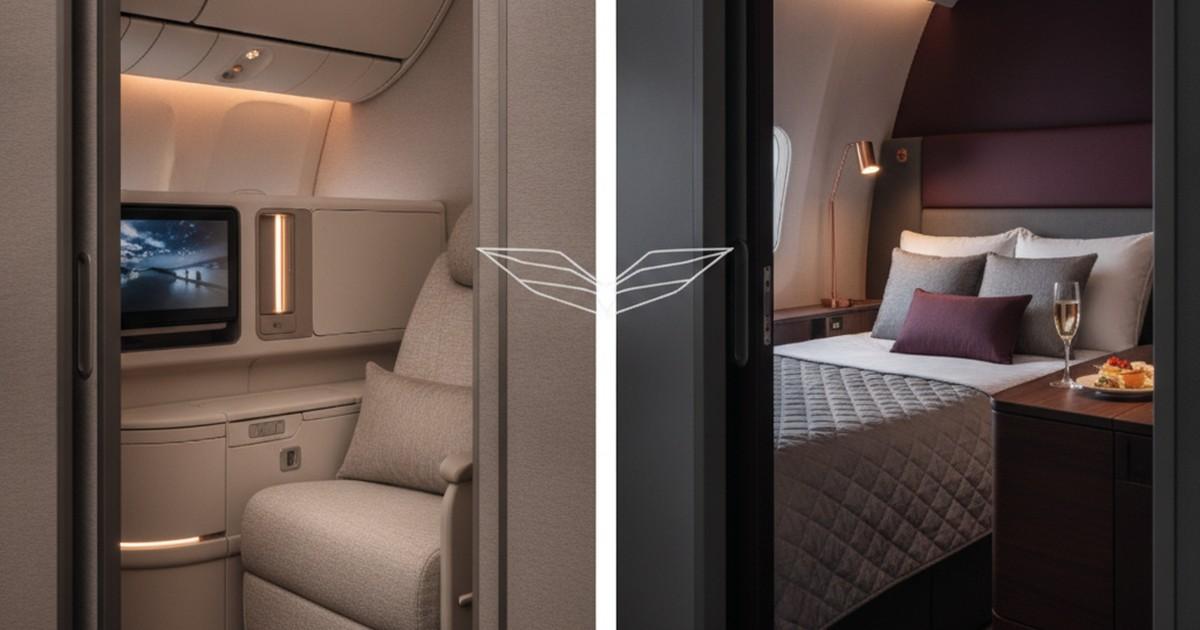
Comparing Etihad's Business Studio vs Qatar's Private Suite

Qatar Airways' Qsuite (and its private Business Suite) is the superior business class seat by a clear margin due to its unparalleled privacy doors, flexible quad configurations, and larger dimensions. However, Etihad Airways' newer Business Studios (on the A350-1000 and 787-9) run an incredibly close second, delivering a luxurious, door-enclosed sanctuary of their own at a more competitive price point.
Here is a quick look at how these two industry-leading premium cabins compare side-by-side:
- Privacy Winner: Qatar Qsuite offers full-height sliding doors and adjustable center partitions. Etihad's newer A350-1000 "Business Studio" also features sliding doors, but older Boeing 787 and Airbus A380 models have open-aisle layouts with alternating rear/forward seats.
- Space & Dimensions: Qatar's Qsuite provides a slightly wider seat (up to 22.25 inches) and an expansive lie-flat bed reaching up to 82 inches. Etihad's newest studios measure 21 inches wide with a 79-inch flatbed.
- Socializing & Quad Configuration: Qatar's unique "Quad" layout allows families or colleagues to convert four center suites into a shared social space. Etihad's Business Studios are built purely for solo or couple privacy.
- In-Flight Technology: Both feature impressive tech, but Etihad's newest A350 cabins edge ahead with built-in wireless phone charging, 18.5-inch 4K touchscreen displays, and Bluetooth pairing.
What are the main design differences between Etihad's Business Studio and Qatar's Qsuite?
Qatar's Qsuite is famous for its 1-2-1 alternating configuration where some seats face forward and others face backward. The backward-facing seats are closer to the window, whereas forward-facing ones are closer to the aisle (or vice versa in the center). The real magic of Qatar is its customized "Quad" concept where the middle seats can have their partition walls completely slid aside, creating a private cabin for up to four people. On the newest B787-9s, Qatar uses the Adient Ascent seat, which is a customized reverse-herringbone private suite with a door.
Etihad’s classic Business Studio (found on the Boeing 787 and Airbus A380) uses a staggered 1-2-1 layout. Some face backward and some forward, featuring high privacy shells but no physical sliding door. However, Etihad revolutionized this with their new A350-1000 and updated 787-9 aircraft. On these planes, Etihad opted for the Collins Aerospace Elevation seat—a customized reverse-herringbone seat that adds a sliding privacy door, making it a true suite.
When these two middle east giants face off, the choice often comes down to the exact aircraft you fly. If you fly Etihad's A350-1000, you are getting a modern, door-equipped private suite that rivals the Qsuite in style and peace.
Which seat offers better dimensions and flat-bed comfort?
Qatar Airways' Qsuite offers some of the most generous physical spacing in the sky. Depending on the aircraft, seat widths range from 21 to 22.25 inches, while the flat-bed length extends to an impressive 79 to 82 inches. The bed is wide, comfortable, and offers couples the unique ability to merge two middle seats into a fully flat double bed.
Etihad Airways' Business Studio dimensions differ depending on whether you are flying the newer or older generation cabins. The classic Business Studio on the Boeing 787 features a 22-inch seat width but a shorter bed length of around 73 to 75 inches. The brand-new A350-1000 suite features a slightly narrower 21-inch width but expands the bed length to a full 79 inches, ensuring taller travelers can sleep with ease.
Let's look at the hard specifications of these seats side-by-side:
- Qatar Airways Qsuite (B777 / A350): 21.5 - 22.25 inches wide, 79 - 82 inches bed length, full-height sliding door, staggered forward/backward layout, double bed option.
- Etihad Business Studio (A350-1000): 21 inches wide, 79 inches bed length, 45-inch sliding door, reverse herringbone layout, no double bed option.
- Etihad Classic Business Studio (787 / A380): 22 inches wide, 73 - 75 inches bed length, no sliding door, staggered forward/backward layout, no double bed option.
For sleeping, Qatar provides a full mattress topper, thick duvet, large pillow, and signature White Company pajamas, giving it a solid edge. Etihad combats this with their sleek Armani/Casa collaboration, featuring plush pillows, a heavy duvet, and memory foam mattress pads. No matter which you fly, the luxurious amenities and service standards of these Gulf carriers ensure you get a solid night's sleep over the Atlantic or Indian Ocean.
How does the privacy compare between the two business class suites?
Privacy is the number one criteria for modern business class travelers. Qatar's Qsuite was the pioneer of business class privacy doors. The doors on the Qsuite are roughly 53 inches tall, completely sealing you off from the aisle. If you are standing up, you can see inside, but when you are seated or lying down, you are in your own private room.
The "Do Not Disturb" indicator light turns red to tell the crew you are sleeping. This physical divider stands high enough to block visual distractions from passing passengers and cabin carts, ensuring absolute tranquility throughout your journey. In the center section, the movable panels can be adjusted. You can raise a solid divider if you are next to a stranger, lower it to make a double bed for a couple, or open the entire cross-partition to create a four-person workspace.
Etihad’s new A350 Business Studio features a 45-inch sliding door. While slightly lower than Qatar's door, it still provides incredible isolation. Because the seats are arranged in a reverse-herringbone layout (angled away from the aisle), you naturally look toward the window rather than the corridor. This means you feel extremely secluded even when the door is open. On Etihad's classic 787s, there are no doors, but the high-shell wrap-around wings of the seat block out most visual distractions.
How does the in-seat technology and storage stack up?
In-seat technology is where the newer planes show their age advantages. Qatar Airways' Qsuite features a highly reliable Oryx One entertainment system. It boasts a 21.5-inch HD touchscreen, accompanied by a smaller touchscreen controller. The suite offers universal AC power outlets, dual USB-A ports, HDMI inputs, and NFC capabilities.
On newer Boeing 777 flights, Starlink Wi-Fi is being introduced, providing ultra-fast internet connectivity. Storage is managed via a large padded side ottoman that opens up to hold headphones, water bottles, and electronics, doubling as an adjustable armrest. Qatar also includes dedicated small slots for mobile devices and safety cards, keeping your immediate space completely clutter-free.
Etihad’s A350-1000 Business Studio is a tech lover's dream. It features an 18.5-inch 4K touchscreen display that supports Bluetooth audio pairing, allowing you to use your own noise-canceling headphones without cumbersome adapter cords. Furthermore, it incorporates a dedicated wireless charging dock integrated directly into the side table, alongside USB-A, USB-C, and universal AC outlets. Storage is incredibly smart, including a custom headphone hook, an adjustable dining table with a built-in book/tablet holder, and a deep, latching side bin to hide your personal items.
How do catering and lounge experiences impact the overall seat journey?
The seat is only one part of the business class equation. To truly compare Etihad’s Studio vs Qatar’s Private Suite, you have to look at the ground-to-air ecosystem.
Both airlines excel at on-board dining. Qatar is legendary for its dine-on-demand service, letting you order caviar or steak at any point. Etihad also offers an exceptional dine-on-demand structure on its long-haul routes. To see how their culinary offerings compare dish-for-dish, check out our deep-dive review and explore their dine-on-demand dining service.
On the ground, your seat ticket opens the doors to some of the most opulent terminal lounges in the world. Qatar's Al Mourjan Business Lounge at Hamad International Airport in Doha is a massive, cathedral-like space with sit-down dining, water features, and quiet sleep pods. It spans over 10,000 square meters, offering multiple distinct dining rooms, a business center, and dedicated family spaces to meet every traveler's operational needs.
Etihad's terminal lounges at the newly opened Zayed International Airport (Terminal A) in Abu Dhabi offer stunning multi-floor architecture, relaxation areas, and gourmet buffets. The Etihad lounge features a dedicated Constellation Bar, direct boarding access for select gates, and private relaxation rooms that let you decompress effortlessly before long-haul sectors. You can compare these hubs directly before your flight at the lounge experience in Abu Dhabi and Doha.
Which airline is the better option for your next booking?
Making the final call between Etihad and Qatar comes down to price, alliances, and routing.
If you are a member of the oneworld alliance, Qatar Airways is the undisputed choice. Qsuites can easily be booked using Avios or partner miles, offering outstanding value. Qatar also boasts a massive global network serving over 170 destinations, making it easier to find a matching flight pattern.
Etihad, while not part of a major alliance, maintains close partnerships with individual carriers like Air France-KLM and JetBlue. However, Etihad's biggest competitive advantage is its price. On identical routes from Europe or the US to Asia and the Middle East, Etihad's Business Studios are consistently priced 10% to 20% cheaper than Qatar's Qsuites. Additionally, you should evaluate their transit hubs to determine which carrier delivers a better connection experience during transit.
Ready to experience these elite cabins yourself? Before booking, map out your route to ensure your specific flight features Qatar's Qsuite or Etihad's door-equipped A350-1000. Use your favorite points calculator to find the best redemptions and lock in your next luxury flight today!



 Saily eSIM