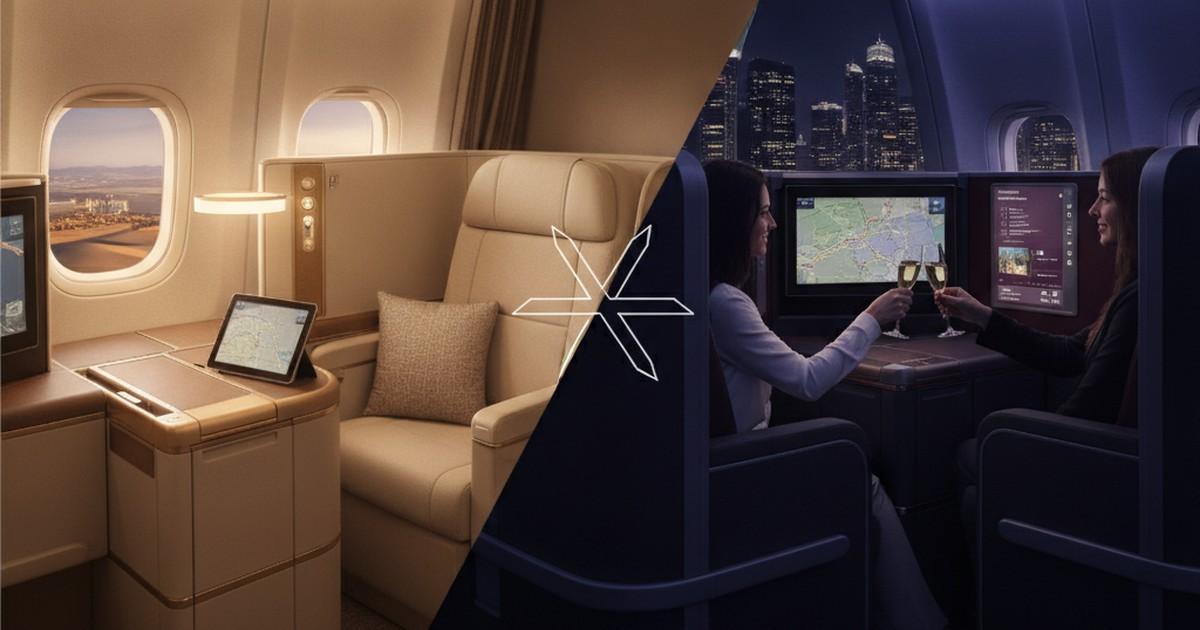

Etihad Business Studio vs Qatar Qsuite Middle East Giants Face Off
Qatar Qsuite is widely considered the superior overall business class product due to its fully closing double-doors, unique quad-cabin flexibility, and unparalleled dine-on-demand service, though Etihad’s newest Business Studio provides exceptional comfort, sliding privacy doors on the A350, and a world-class premium airport experience. While both carriers represent the absolute pinnacle of commercial aviation luxury, your final choice will come down to your route, aircraft model, and preference for onboard socializing.
The Quick Takeaways (TL;DR)
- Seat Privacy: Qatar Qsuite provides high sliding doors across its Boeing 777 and Airbus A350 fleets, while Etihad offers sliding doors exclusively on its newer Airbus A350-1000 and modern Boeing 787 variants.
- Dine on Demand: Qatar Airways offers true dine-on-demand flexibility where you eat exactly when you want, whereas Etihad features a highly structured but exceptionally delivered culinary service.
- Innovative Layouts: Qatar’s famous "Quad" seat configuration allows four passengers to face each other in a private room, which remains unmatched for families and corporate teams.
- Hub Airports: Qatar transits through Doha’s massive Hamad International Airport, while Etihad operates out of Abu Dhabi’s state-of-the-art Zayed International Airport (Terminal A).
Which seat offers better privacy and comfort?
When it comes to physical comfort, comparing the seats reveals that both airlines have set incredibly high benchmarks for long-haul travel. Qatar Airways’ Qsuite offers 21.5 inches of seat width and a fully flat bed measuring 79 inches in length. Its true competitive advantage lies in its high sliding door, which completely isolates you from the cabin aisle. Additionally, the middle seats can combine to form double beds, or even open up into a four-person social suite, transforming business class into an adaptive private bedroom.
Etihad Airways' Business Studio on older Boeing 787-9s lacks sliding doors but provides a highly private dovetail layout with forward and rear-facing seats. On its newer Airbus A350-1000s, Etihad has introduced its latest Business Suite with fully sliding privacy doors. These new suites feature 22 inches of width, a 78-inch flatbed, and a customized Collins Aerospace Elements frame built to maximize legroom.
Ultimately, Qatar's Qsuite wins the privacy battle on its Boeing 777-300ER and Airbus A350 fleets because of its incredibly high, sliding door. While Etihad's new A350 Business Suite matches this privacy, older configurations on other aircraft lack doors entirely. Both layouts provide direct aisle access, but Qatar’s adaptive dividers provide a distinct edge.
How do the onboard menus and dining experiences compare?
The culinary duel between these Middle Eastern heavyweights is a masterclass in premium hospitality, but their service models differ significantly. Qatar Airways is famous for its strict adherence to a true dine on demand model on every single long-haul flight. This means you can order anything from the extensive menu—ranging from their signature Arabic mezze to a multi-course dinner or a late-night warm chocolate pudding—at any time during the flight, in any order you choose.
Etihad Airways features a highly structured dining flow that operates on a reliable dine-on-demand setup. Etihad elevates its presentation through a partnership with luxury brand Armani/Casa, which provides custom tableware and premium linens. Their menu highlights authentic Arabic specialties alongside modern international options, delivered with exquisite attention to detail.
While Etihad’s presentation is incredibly stylish, Qatar Airways wins on flexibility. Ordering a full meal hours before landing is a seamless reality with Qatar. Their expansive wine program and high-end French champagne selection also outmatch Etihad's more modest beverage list.
What are the differences in the soft product and amenities?
In the aviation world, the soft product consists of the physical non-seat items that define your comfort, including bedding, pillows, pajamas, and amenity kits. Both Etihad and Qatar spare no expense in this category, recognizing that these luxury touches are what business class passengers remember long after they land. Qatar Airways partners with the luxury French fragrance house Diptyque to provide beautiful amenity kits filled with premium body lotions, essential face creams, and signature fragrances. On long-haul flights, Qatar also provides high-quality pajamas and slippers from The White Company, paired with a plush mattress pad, a heavy duvet, and a full-size pillow for sleeping.
Etihad Airways matches this high bar with Giorgio Armani and ESPA amenity kits and a premium Armani/Casa bedding set. Passengers enjoy a thick mattress topper, a heavy quilted blanket, and an ergonomically designed pillow. On flights exceeding eight hours, Etihad offers high-quality loungewear and slippers. While Qatar's cabin crew is highly disciplined, Etihad's service has a warmer, more personable quality.
Whether you prefer the corporate polish of Qatar’s flight attendants or the friendly warmth of Etihad’s crew, you will receive world-class care on both carriers. However, Qatar’s Diptyque kits and the consistency of its turn-down service give it a slight advantage for passengers who prioritize sleep and skincare during ultra-long-haul flights.
Which airport has the superior business class lounge?
The pre-flight and transit experience at an airline's hub can dramatically influence your journey. Comparing the lounge experience between Hamad International Airport (DOH) in Doha and Zayed International Airport (AUH) in Abu Dhabi reveals two architectural masterpieces. Qatar Airways’ flagship Al Mourjan Business Lounge at Hamad International is legendary, featuring high ceilings, multiple dining rooms, a massive water feature, and quiet sleeping areas. The newer Al Mourjan Lounge at "The Garden" expansion overlooks an indoor tropical forest, offering an oasis of calm with a spa, gym, and private relaxation pods.
Etihad has transformed its hub offering at Zayed International Airport's Terminal A. The brand-new flagship Etihad Business Class Lounge is a three-story space featuring direct boarding gates, letting you step straight from the lounge onto your flight. It offers the iconic Constellation Bar, live-cooking stations, day beds, and dedicated wellness rooms, making for an incredibly fresh and uncrowded environment.
Doha's Al Mourjan remains an absolute titan in terms of scale and historical prestige, but Etihad’s new Terminal A lounge in Abu Dhabi is arguably more convenient for transit passengers. The direct-boarding gates and the sheer freshness of the Abu Dhabi facilities make it a highly competitive alternative to the often-busy lounges in Doha.
How do the airline connection and transit experiences compare?
A seamless transfer is essential when flying between continents, and your connection experience will vary based on the layout of these massive hubs. Hamad International Airport in Doha is a highly efficient, single-terminal mega-hub designed to handle tens of millions of passengers annually. It features an automated indoor train to connect distant gates and is packed with luxury shopping, art installations, and a giant yellow teddy bear sculpture that serves as a global meeting point. However, because Qatar Airways is so large, security lines and transit gates can become incredibly busy during peak midnight and early morning banks of flights.
Abu Dhabi’s Zayed International Airport, particularly the new Terminal A, is designed with a highly intuitive, X-shaped layout that minimizes walking distances. Security screening is incredibly fast, utilizing state-of-the-art biometric technology that allows passengers to glide through checkpoints with minimal hassle. Because Etihad operates a smaller overall fleet than Qatar, the terminal rarely feels overwhelmingly crowded, creating a much more peaceful and relaxing transit environment. If you value a calm, fast, and stress-free connection over a bustling mega-hub with endless shopping, Etihad's Abu Dhabi hub is the superior choice.
How do they hold up against other global business class giants?
To understand just how exceptional these two Middle Eastern products are, it helps to compare them to other business class offerings around the world. On transatlantic routes, the classic battle of United Polaris vs Delta One highlights how American carriers have improved their privacy doors and bedding. However, neither Polaris nor Delta One can compete with the extensive food and beverage options or the luxurious lounge networks provided by Etihad and Qatar. Similarly, when examining American Airlines Flagship vs United Polaris, the domestic and international premium products from the United States still feel highly standardized compared to the bespoke, high-end hospitality of the Gulf carriers.
Across the Atlantic, European airlines are also attempting to close the gap. The rivalry between the British Airways Club Suite vs Virgin Atlantic Upper Class shows a massive shift toward sliding privacy doors and customized social spaces. Yet, the overall dining presentation and airport transit experiences of these UK airlines still struggle to match the opulence of the Middle East. Similarly, the match-up of Lufthansa vs Air France showcases excellent European gastronomy, but their business class cabins are often inconsistent across older and newer aircraft types, whereas Qatar and Etihad offer far more modern fleets.
In Asia, comparing Singapore Airlines vs Cathay Pacific highlights remarkable cabin service, though Singapore's standard seat lacks a closing door. For premium cabins, examining ANA The Suite vs JAL First Class displays superb private first-class luxury, whereas their standard business class relies heavily on route-by-route consistency. Similarly, the duel of Korean Air Apex Suite vs Asiana shows outstanding hardware, but both lack the modern soft product design found on Middle Eastern carriers.
Within the Middle East, the Qatar Qsuite vs Emirates Business Class rivalry reveals that while Emirates offers an iconic A380 lounge bar, its Boeing 777 fleet relies on a restrictive 2-3-2 layout. Indeed, Qsuite is so advanced it is frequently compared to first class products, such as Singapore Airlines Suites vs Emirates First, proving that modern business class often rivals top-tier luxury.
What is the final verdict and which should you book?
To make your final decision, consider the specific aircraft flying your route. If you are flying on a Qatar Airways Boeing 777 or Airbus A350 equipped with Qsuite, book it without hesitation for the absolute best privacy, dine-on-demand service, and bedding available in commercial aviation. If your route is operated by an Etihad Airbus A350-1000 or a new Boeing 787 with the modern sliding-door Business Suites, you will enjoy an incredibly comparable seat, faster transit times in Abu Dhabi, and the stunning Armani/Casa dining aesthetics.
Ready to plan your next luxury adventure? Check your flight’s aircraft configuration before booking, compare the award availability through Etihad Guest or Qatar Airways Privilege Club, and secure your private suite in the sky today.



 Saily eSIM