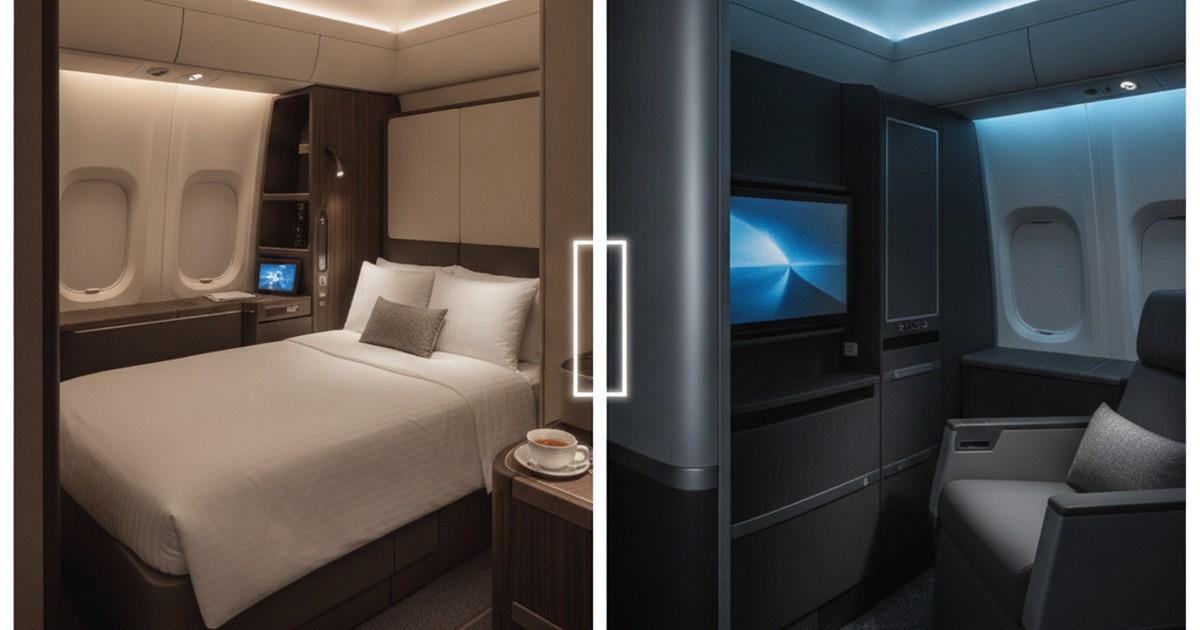

First Class Suite Design ANA's The Suite vs JAL's Sky Suite
When booking a premium ticket to Japan, choosing between ANA's "The Suite" and Japan Airlines' (JAL) flagship First Class suites comes down to whether you prefer dark-wood minimalism or spacious, high-tech innovation. ANA’s "The Suite" (Boeing 777-300ER) features a masterfully designed 1-2-1 private cabin with a massive 43-inch 4K monitor, while JAL’s revolutionary Airbus A350-1000 First Class suite offers a groundbreaking 1-1-1 layout, headphone-free headrest audio, and an ultra-wide 48-inch convertible sofa-bed.
TL;DR: Key Takeaways
- Layout & Exclusivity: ANA utilizes a standard 1-2-1 layout with 8 suites on the Boeing 777-300ER, whereas JAL's flagship Airbus A350-1000 features a hyper-exclusive 1-1-1 layout with only 6 suites.
- Bed & Seat Dimensions: JAL's new A350 suite boasts a massive 48-inch-wide seat that converts into a double bed, easily outclassing ANA's 33-inch-wide "The Suite" seat.
- Technology: While both showcase beautiful 43-inch 4K monitors, JAL dominates with wireless charging pads and world-first headphone-free headrest speakers.
- Cabin Vibe: ANA delivers dark, cozy, corporate minimalism with full-closing sliding doors, while JAL focuses on airy, open-concept luxury by eliminating overhead bins.
What is the layout of ANA's "The Suite" versus JAL's First Class cabins?
The cabin architecture of these two Japanese giants represents entirely different philosophies of space and luxury. ANA's "The Suite" is exclusively installed on a select fleet of refurbished Boeing 777-300ER aircraft, featuring a traditional two-row, 1-2-1 configuration that accommodates eight passengers. The dark, matte-finished outer shells create a highly private, corporate aesthetic reminiscent of a high-end luxury office.
In contrast, JAL operates two distinct first-class configurations across its long-haul fleet. The older Boeing 777-300ER "JAL Suite" layout mirrors ANA's with eight seats arranged in a 1-2-1 pattern, though it utilizes open-concept, wood-grain partitions without sliding doors. However, JAL's modern flagship Airbus A350-1000 completely disrupts this standard by introducing a hyper-exclusive 1-1-1 layout across just two rows, limiting the cabin to six ultra-private spaces.
By shifting to a three-across configuration on the Airbus A350-1000, JAL has unlocked unprecedented physical space for each passenger. Additionally, the airline has removed all overhead storage bins from the first-class cabin, making the ceiling feel incredibly high and spacious. This layout design provides a level of luxury and roominess that rivals private jet travel.
How do the physical dimensions and bed comfort compare?
If seat width and sleeping versatility are your top priorities, JAL's newest Airbus A350-1000 First Class suite is the clear winner. This Safran-designed seat measures an astonishing 48 inches (123 cm) wide, which is roughly equivalent to 2.6 standard economy seats side-by-side. The sheer width allows passengers to configure the seat as a wide sofa, a single chair with a separate side bed, or a full double bed.
ANA’s "The Suite" is certainly not cramped, but it adheres to more traditional premium dimensions. It features a seat width of 33 inches (84 cm) and a comfortable 76-inch pitch that converts into a fully flat bed. For sleeping comfort, ANA provides high-end Nishikawa dual-layered mattresses, allowing travelers to choose between a soft or firm sleeping surface during their long-haul flight.
JAL's legacy Boeing 777-300ER "JAL Suite" offers a seat width of 33 inches and a bed length of 79 inches, utilising custom-designed Airweave dual-mode mattresses. While these older B777 seats are exceptionally comfortable, they lack the multi-functional sofa configurations found on the newer A350. JAL's newer flagship model takes bed width up to 48 inches, offering the most spacious sleeping canvas currently flying.
Which suite has the better in-flight entertainment and technology?
Technology is an area where both airlines have made massive leaps, but their execution differs significantly. ANA’s "The Suite" features a jaw-dropping 43-inch 4K resolution screen that stretches wall-to-wall across the front of the cabin partition. This screen is not touch-sensitive, but it is easily controlled via a sleek, handheld tablet, offering a cinematic home-theater experience in the sky.
JAL matches ANA's screen size on its Airbus A350-1000 with its own gorgeous 43-inch 4K screen, but pairs it with revolutionary audio technology. The JAL suite features the world's first headphone-free stereo system integrated directly into the headrest. Developed in partnership with Safran, these built-in headrest speakers allow you to enjoy high-fidelity movie audio without the physical fatigue of wearing heavy noise-cancelling headphones.
Furthermore, JAL’s A350 suites are packed with modern charging solutions, including integrated wireless charging pads, USB-C, USB-A, and universal AC outlets. ANA's "The Suite" also includes a wide array of power ports, including a HDMI port, though it lacks the convenience of wireless charging. If you are flying JAL's older Boeing 777-300ER, however, you will have to settle for a legacy 23-inch screen that lacks 4K resolution.
How does storage and privacy compare between the two?
Privacy is a crucial differentiator, particularly when comparing ANA's newer sliding doors with JAL's older open-style configurations. ANA's "The Suite" features high, heavy sliding double doors that fully close to create a completely enclosed personal sanctuary. When closed, these doors rise high enough to block out the view of the cabin aisle entirely, giving you absolute isolation.
JAL's legacy Boeing 777 suites do not feature closing doors, relying instead on wood-paneled privacy screens that slide up halfway. This design choice fosters a more open, airy cabin environment, but it does leave passengers somewhat exposed to passing crew and travelers. If you value complete physical isolation, the older JAL B777 suites might feel slightly underwhelming compared to ANA's robust enclosures.
Fortunately, JAL addressed this on their Airbus A350-1000 by installing tall, translucent sliding privacy doors that stand 157 cm (62 inches) high. JAL also optimized storage by building a private, full-length wardrobe inside every single A350 suite, allowing you to hang coats and store garments. ANA’s "The Suite" has smaller, jacket-sized wardrobes, but forces you to store larger carry-on luggage in the overhead bins, whereas JAL lets you slide maximum-sized bags under the ottoman.
How do dining, service, and ground lounges impact the overall suite experience?
While the physical hardware of your suite is vital, the surrounding soft product can make or break a first-class journey. To truly understand how these airlines compare across all aspects, you can read our deep-dive comparison to explore the subtle nuances between their cabins. From the moment you step on board, both carriers embody the legendary omotenashi factor where flight attendants anticipate your every need with quiet, warm, and highly personalized hospitality.
The culinary journey on both airlines is another area of extreme luxury. Passengers can indulge in carefully curated first class menus showcasing seasonal Kaiseki dining, premium caviar courses, and legendary beverages like Krug champagne or rare Hibiki Japanese whisky. ANA tends to offer a slightly more modern take on Western dishes, while JAL focuses heavily on Michelin-caliber traditional multi-course dining experiences.
Your luxury journey begins well before boarding with an exceptional ground experience at Tokyo Haneda or Narita airports. JAL’s First Class Lounge stands out for its unique JAL Salon, on-demand sushi bars, and teppanyaki dining areas. Meanwhile, ANA’s Suite Lounge offers quiet work cubicles, private dining rooms, and custom noodle bars that set a relaxed, upscale tone for your upcoming flight.
How can you book these ultra-exclusive first-class designs using points?
Securing a first-class ticket on either of these prestigious airlines using miles is one of the most rewarding redemptions in the entire points-and-miles hobby. Because cash rates for these routes regularly exceed $15,000 one-way, using credit card transfer partners is the most realistic way to fly them. Fortunately, you can read our comprehensive how-to guide to secure these seats before they disappear.
For ANA's "The Suite," your best booking strategy involves using Virgin Atlantic Flying Club points or Air Canada Aeroplan miles. Virgin Atlantic offers some of the most competitive award rates, starting at just 55,000 to 85,000 miles one-way depending on your US gateway. Keep in mind that ANA release schedules are highly competitive, and finding seat availability requires planning up to 355 days in advance.
If you prefer JAL’s First Class suites, your primary award currencies will be American Airlines AAdvantage miles, Alaska Airlines Mileage Plan miles, or British Airways Avios. American Airlines offers excellent value at roughly 80,000 miles one-way between the US and Japan with minimal cash surcharges. JAL is known to release unsold first-class seats to partner programs close to the departure date, making last-minute bookings highly viable for flexible travelers.
What is the next step to plan your premium flight to Japan?
Now that you know the structural, technological, and design differences between ANA's "The Suite" and JAL's flagship first-class offerings, it is time to check award space. Open up your preferred airline search tool, verify the exact aircraft operating your desired route, and secure your seat today.



 Saily eSIM