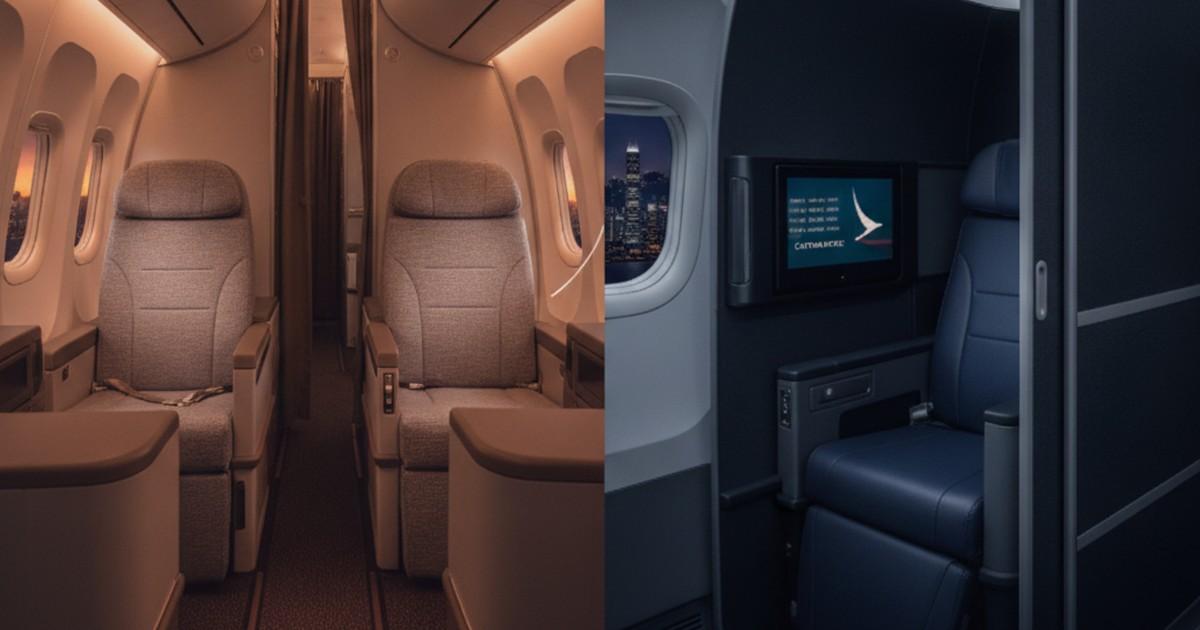
Seat Comfort: Singapore's Width vs Cathay's Privacy
 When deciding between Singapore Airlines vs Cathay Pacific business class seat comfort, Singapore Airlines dominates in terms of sheer seat width, whereas Cathay Pacific excels at personal privacy. Singapore’s ultra-wide 28-to-30-inch seats provide unparalleled space to lounge, while Cathay’s reverse-herringbone configuration—spearheaded by its new Aria Suite—offers a private, door-closed sanctuary that isolates you from the cabin aisle.
 Here is a quick breakdown of how these two premium cabins stack up:
- Singapore Airlines (SQ): Offers massive seat width (28-30 inches), high-quality leather, and a spacious forward-facing 1-2-1 layout, but lacks sliding privacy doors on its current classic long-haul fleet.
- Cathay Pacific (CX): Uses a private 1-2-1 reverse herringbone configuration angled away from the aisle, with the new Aria Suite introducing full closing doors, wireless charging, and 24-inch 4K screens.
- Sleeping Comfort: SQ requires sleeping at a diagonal angle due to its offset footwell, while CX allows you to sleep straight aligned with the seat axis.
- Verdict: Choose Singapore Airlines for lounging space and seat width; choose Cathay Pacific for absolute privacy, sleep ergonomics, and cutting-edge suite technology.
Why is the Singapore Airlines business class seat so wide?
Singapore Airlines is famous for having some of the widest business class seats in the commercial aviation industry. Their standard long-haul Business Class seat (known as the 2013J product) measures a massive 28 to 30 inches in width. To put this into perspective, most competing airlines offer business class seats that range between 20 and 22 inches wide.
This incredible width is made possible by the 1-2-1 configuration on the Airbus A350-900 and the Boeing 777-300ER. Because the Boeing 777 has a slightly wider cabin fuselage, passengers on that aircraft get an extra half-inch of shoulder space. The seats are upholstered in premium Scottish leather with an elegant diamond-stitch pattern, giving the cabin a warm, luxurious feel.
On the Boeing 777-300ER, Singapore Airlines provides a seat pitch of 55 inches and a bed length of 78 inches. This generous footprint allows travelers to sit comfortably with their knees bent or fully extended, enjoying a level of lateral space that is unmatched in other cabins. If you are someone who likes to shift positions frequently or sit cross-legged while working, this extra width is a massive advantage.
For a deeper look at how these products match up overall, check out our business class review. While the wide dimensions are great for sitting, they do require a unique sleep configuration. Because the seat is so wide, the footwell is shifted to one side, which directly impacts how you sleep on long-haul routes.
Does Cathay Pacific offer better privacy than Singapore Airlines?
Yes, Cathay Pacific provides a significantly higher level of privacy than Singapore Airlines' current standard business class configuration. Cathay Pacific utilizes a reverse herringbone layout, which angles window seats toward the windows and center seats toward each other. This physical angling means your face is naturally shielded from the aisle, preventing direct eye contact with passing crew members or other passengers.
Cathay Pacific’s standard reverse herringbone seat offers a solid 21 inches of width. It is narrower than Singapore's product but still highly comfortable due to the sculpted armrests that lower to expand the sleeping width. When fully flat, the bed extends to 78 inches, giving you plenty of room to stretch. This design choice highlights how Cathay prioritizes efficient use of space to maximize quiet luxury rather than trying to build the widest seat possible.
The privacy gap has widened even further with the introduction of Cathay Pacific's new Aria Suite. Deployed on reconfigured Boeing 777-300ER aircraft, the Aria Suite features a fully functional sliding privacy door. It also boasts a high wrap-around seat shell and a sliding middle partition for passengers traveling together.
Singapore Airlines' classic long-haul business class seats do not feature closing doors. While the high seat shells offer good visual separation from the sides, your seat remains entirely open to the aisle. If you value a closed-door "suite" experience where you can completely block out the rest of the cabin, Cathay Pacific's Aria Suite is the clear winner.
How does the sleeping experience compare on Singapore vs Cathay?
The sleeping experience is one of the most polarizing differences between these two world-class airlines. Singapore Airlines' seats must be manually flipped forward by the cabin crew to convert them into a fully flat bed. While this ensures a perfectly crisp, upholstered sleeping surface with no uncomfortable seat seams, it prevents you from gradually reclining into a bed at the touch of a button.
Additionally, the SQ bed requires you to sleep diagonally. Because the headrest flips down and the footwell is carved into the corner of the seat console in front of you, you cannot lie straight down. Taller travelers frequently complain that their feet hit the back wall of the footwell, which can feel restrictive on a 12-hour flight.
Cathay Pacific, on the other hand, allows you to transition seamlessly from upright to lie-flat mode using intuitive electrical controls. The bed extends straight ahead, allowing you to sleep aligned with the seat's natural axis. Combined with premium Bamford bedding and a mattress topper, the physical layout of Cathay's bed is often considered more natural and comfortable for side sleepers.
The outstanding attention to detail in Cathay's cabin design is mirrored in their on-board service styles, which focus on intuitive, non-intrusive hospitality. Whether you prefer a wide, open bed or a private, straight-aligned sleeping cocoon, both carriers deliver exceptional comfort, but the ergonomics differ wildly.
What is the difference in seat layout and cabin configuration?
While both airlines utilize a 1-2-1 seat layout, the orientation of the seats changes the entire cabin dynamic. Singapore Airlines uses a forward-facing configuration where every seat points directly toward the cockpit. This layout makes the cabin feel incredibly spacious and open, but it also means passengers are highly visible to anyone walking down the aisle.
Cathay Pacific employs the reverse herringbone configuration, which organizes the cabin diagonally. This layout maximizes space efficiency while naturally creating individual private zones. The window seats (A and K) point directly at the windows, making them excellent for viewing, while the center seats (D and G) point slightly toward the center line.
Your choice of layout may also influence your overall travel routine, from dining to pre-flight relaxation. For instance, the layout differences extend to how dining is structured, which you can read about in our guide to dining service options. Furthermore, your on-board comfort is always complemented by what happens on the ground, making a detailed airport lounge comparison essential before booking.
Which airline has better seat storage and in-seat technology?
Cathay Pacific’s recent fleet updates have given it a substantial advantage in modern in-seat technology and storage. The Aria Suite comes equipped with a brilliant 24-inch 4K HDR entertainment screen, Bluetooth audio streaming, and integrated wireless charging. The suite also features well-placed, felt-lined storage compartments to keep your personal items secure and scratch-free.
The storage options in Cathay’s classic reverse herringbone seat are also highly practical, including a side cabinet that houses the noise-cancelling headphones and a vanity mirror. The new Aria Suite builds on this by adding a dedicated drawer for small devices and a slide-out drawer under the footrest. This keeps your personal space completely clutter-free throughout a long-haul journey.
Singapore Airlines' classic business class seat is starting to show its age in the technology department. It features an 18-inch high-definition screen, which is still excellent but lacks the pristine contrast of 4K and does not natively support wireless charging. However, SQ has announced a major cabin refit commencing in Q2 2026 to bring closing doors and upgraded tech to its long-haul fleet.
For a complete breakdown of how the screens, Wi-Fi speeds, and remote controls compare, check out our cabin tech comparison. Having reliable, fast technology is critical for productivity on ultra-long-haul flights. Currently, Cathay’s tech-forward Aria Suite is the superior workspace in the sky.
Singapore vs Cathay: How do you choose the right seat for you?
To make the final decision, consider how your body type, sleeping habits, and privacy preferences align with each airline's unique layout:
- Choose Singapore Airlines if:
- You prefer an ultra-wide seat where you can sit cross-legged or lounge with plenty of hip room.
- You like a forward-facing layout that feels open and airy.
- You enjoy a crisp, dedicated mattress surface created by a flip-over bed.
- Choose Cathay Pacific if:
- You want maximum privacy, especially if you can book the door-closed Aria Suite.
- You prefer sleeping straight down rather than at a diagonal angle.
- You want the latest tech, including wireless charging, Bluetooth audio, and 4K screens.
- You like adjusting your seat gradually from upright to flat without standing up.
Both carriers offer world-class seats, but they serve completely different passenger priorities. If raw space and width are your primary metrics of comfort, Singapore Airlines remains an unmatched titan. If you prefer a private, quiet haven where you can sleep soundly and control your environment, Cathay Pacific's design is the benchmark to beat.
Ready to book your next business class journey? Check your route's aircraft type to see if Singapore's classic wide seat or Cathay’s new Aria Suite is scheduled for your flight, and secure your window seat today.



 Saily eSIM